Showing posts with label India. Show all posts

Sunday, September 14, 2008

India is the 4th largest country in terms of the GDP (PPP)


You must be thinking that I'm joking or I'm talking about 2025. No Im not. These are figures of the year 2007 given by IMF and World Bank. I will come to that in a while. Lets forget that for a moment.

I was just browsing to get some comparative index of the living standard of people across different countries in the world and their purchasing power. How do you do that?

For a long time, GDP (Gross domestic product) and GDP per capita used to be the benchmark for that.

In simple terms, wiki says:
GDP = consumption + gross investment + government spending + (exports − imports).

Next came the Human Development Index.

Wiki says:
This index is a normalized measures of life expectancy, literacy, educational attainment, and GDP per capita for countries worldwide.

But if I understood these correctly, it does not take into account the purchasing power of an individual.. Lets take two countries - India and Germany. Their respective currencies are Euro and Rupee. The exchange ratio between these two currencies is 1Euro = 65Rs approximately. So lets compare a service in both countries.. I take the haircut. In Germany, it costs 10Euro minimum in general. In India, It may cost 100Rs max in big cities for an above average one. (Although you can avail that service at much cheaper rate, I kept the Indian one slightly on the higher side to have a correction factor for quality of service.) Now, simple maths says that the cost of the haircut is 6.5 times cheaper in India. So if we take the haircut as a benchmark, the German need to earn 6.5 times the Indian to have the same living standard. Obviously, the values are way of target, but my point is that, just because an Indian may earn less doesn't necessarily mean that he may have a lower living standard. Thankfully, people who know these things have made another index to make necessary correction to account for the difference in living cost.

That is PPP (Purchasing power parity)

Wiki says:
The purchasing power parity (PPP) theory uses the long-term equilibrium exchange rate of two currencies to equalize their purchasing power.

India ranks 12th by GDP but 4th by PPP.


Fig Courtesy Wikipedia.


See the following link to get the ranks based on PPP.
http://en.wikipedia.org/wiki/List_of_countries_by_GDP_(PPP)


Thus you can see that India is the 4th largest economy in the world today, bigger than Germany and UK.
(based on GDP-PPP).

As you would read in those pages, this, by no means, cannot be considered as the absolute index for comparison. But this will give you a perspective of the purchasing ability of the people, which is missing in other indexes.


Footnote:

Even PPP is a Gross Income. It means that the bigger the population, the bigger the GDP (in general, of course with exceptions). India, due to its size would have come that high in the list.

I think, more than PPP, the PPP/person (PPP per capita) would be a more interesting figure. But here also, the figures would be distorted if the wealth is concentrated among few.

So I think, an even more interesting figure would be the average PPP of the middle 70% of the population. What I meant is this. Remove the top 15% and bottom 15%. Calculate the PPP of the remaining 70%. Divide that value with the no of people that fall into those 70%. Thus you would get the average purchasing ability of the common man in that country.

This is the "Joe's 70% average PPP".


Links:

Gross domestic product

Human Development Index

Purchasing power parity

List of countries by GDP (nominal)

List of countries by GDP per capita

List of countries by Human Development Index

List of countries by GDP-PPP

List of countries by PPP per capita

Sunday, August 17, 2008

6th Pay Commission (INDIA) and calculator


The India Govt. has decided to implement the 6th Pay commission recommendations with effect from from 1st Jan 2006.

This post may not have the comprehensive info on this subject, but just an easy link to the official site (which may not be easily found out) and some basic info ..

The news is that, for most, the revision will be better than the pay commission recommendations, especially for the defence oriented. The Sixth Pay Commission headed by Justice B N Srikrishna submitted in March, its report to the government. It had recommended an average 28 per cent hike for central government staff and defence personnel.

Now the Cabinet has approved the recommendations and there will be a 40 per cent hike for the Central government employees and defence personnel.

However, the arrears will not be disbursed in one go, but will be divided into two components to be given by the end of next year. 40 percent of the arrears will be disbursed in 2008, while the remaining 60 percent will be rolled out after March 2009. The cost to the government will be over Rs.23,000 crores.

As per the cleared proposal, the minimum basic pay will be Rs 7000, while the minimum salary per month at the lowest level will now be Rs 10000.


Click here to go to the calculator links
The official version can be seen at http://www.india.gov.in/govt/paycommission.php

Click here for the excel prepared by Deva Arul Daniel (FDD/ISAC). please check yourself the correctness of this.

The following will give you the table of the original and new scales...


Pre-RevisedRevised
Pay ScalePay ScalePay BandCorresponding Pay BandsGrade Pay
S-12550-55-2660-60-3200-1S4440-74401300
S-22610-60-3150-65-3540-1S4440-74401400
S-2A2610-60-2910-65-3300-70-4000-1S4440-74401600
S-32650-65-3300-70-4000-1S4440-74401650
S-42750-70-3800-75-4400PB-14860-202001800
S-53050-75-3950-80-4590PB-14860-202001900
S-63200-85-4900PB-14860-202002000
S-74000-100-6000PB-14860-202002400
S-84500-125-7000PB-14860-202002800
S-95000-150-8000PB-28700-348004200
S-105500-175-9000PB-28700-348004200
S-116500-200-6900PB-28700-348004200
S-126500-200-10500PB-28700-348004200
S-137450-225-11500PB-28700-348004600
S-147500-250-12000PB-28700-348004800
S-158000-275-13500PB-28700-348005400
S-169000PB-315600-391005400
S-179000-275-9550PB-315600-391005400
S-1810325-325-10975PB-315600-391006100
S-1910000-325-15200PB-315600-391006100
S-2010650-325-15850PB-315600-391006500
S-2112000-375-16500PB-315600-391006600
S-2212750-375-16500PB-315600-391007500
S-2312000-375-18000PB-315600-391007600
S-2414300-400-18300PB-315600-391007600
S-2515100-400-18300PB-315600-391008300
S-2616400-450-20000PB-315600-391008400
S-2716400-450-20900PB-315600-391008400
S-2814300-450-22400PB-439200-670009000
S-2918400-500-22400PB-439200-670009000
S-3022400-525-24500PB-439200-6700011000
S-3122400-600-26000PB-439200-6700013000
S-3224050-650-26000PB-439200-6700013000
S-3326000(Fixed)Apex Scale80000 (Fixed)NIL
S-3430000 (Fixed)Cab.Sec./Equ.90000 (Fixed)NIL


Further Reading...
http://www.tarunreflex.co.cc
http://www.thaindian.com


Sunday, June 22, 2008

best VOIP Rates to India


if you are new to VOIP calls, please have a look at one of my previous posting about this.

The basics are more or less same but, they keep coming up with new sites with better rates.. through this posting I will try to keep u updated about the best rate that I come across with (to India)..


1. VOIP Cheap === 0.07 Euros/Min to India (7 cents / min)


This is what I have been using for some time now.


2. Internet Calls === 0.03 Euros/min to India


I have registed to this site recently.


3. VOIP Raider === 0.022 Euro/Min to Landline and 0.027 Euro/min to mobile. (Even if you calculate with 66Rs per Euro, one minute of call will cost you only 1.5 Rs/- !!!!!!!)


I saw this rate today. I have not registed yet.


4. WebCallDirect === 0.02 Euros/min to landline, 0.03 Euros/min to Mobile. (Super deal)


I found this today..


One more thing. Earlier I was able to pay using credit card. Now a days, it doesnt seem to work at all.. You can do the Bank Transfer or "Elektronisches
Lastschriftverfahren" (if you are in Germany) or its equivalants...


Watch this space for better rates that I find.


[Added on 13.09.2008]
5. CallEasy === 0.02 Euros/min to landline and Mobile. (Super deal)


Only difference from other sites is that this does not allow people to call from PC to phone. Instead you need to make a call to an access number and use the pin to login and then enter the destination number.

The catch with this is that, you can use this effectively only if you can call to these access numbers for free. For eg, here in Germany, most internet connections comes with telefone-flat, which means you call all landlines in Germany for free. So I use that option to call the access number and further call to India. If you are not able to call these access numbers for free, then its better to go for another option (say WebCallDirect) by which you can make the calls from PC. Or if you already have such an account like WebCallDirect, that will help you to make that first call to access no for free and then use the CallEasy Account.

[Added on 15.09.2008]
6. FreeCall === 0.015 Euros/min to landline and 0.02 Euro/Min to Mobile. (Super deal)


.

Monday, November 27, 2006

Changing India - Change of attitudes


There are few India companies that are going global Like Tata, Reliance etc.. But I was seeing this interview with Baba Kalyani on CNN and I thought I heard something different..

They were discussing about the acquisition made by his company Bharat Forge, now worlds second largest in its field and the way it has emerged in the world arena. Baba Kalyani was saying that what it has achieved is not because of the cheap labour in India, although the perception about India is that its advantage is in making use of cheap labour to make low tech outputs. When he was asked if you are in the Hi tech field, there is no real cost advantage being in India because it cost the same as say in Germany. But his reply was that the difference is in the people (the engineers) who implement the technology and they are as competitive to counterparts in developed countries and the cost advantage because of that.

For me, personally, it was very refreshing to hear the whole interview because I was hearing something that I wanted to hear for sometime now! May be things are changing for good..

Click here to see the video of the interview..

Monday, October 02, 2006

INDIA: A Superpower in the Making?


We, Indians have been hearing this for some time now. Will India be or Can India become a superpower. A few say India can, under certain circumstances, if everything falls in the right place.. But, really, do u believe so..

I was reading this interesting article about this issue and found it interesting.

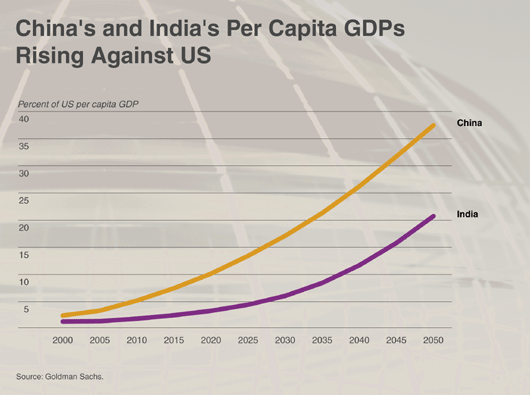
One of the thing it is discussing is the possibility of Indo-China Union, something like EU. Of course, there are still some issues, but that will be dwarfed by the possibilities. Together it will account for almost HALF of world population!! (Ref 5). It may be to early to discuss, but its an interesting prospect. The author discusses this under "A Turning Point in Relations With China?". The same is discussed in a Rediff article as well..

Another interesting thing I found is the parallel he found between the world future and what Bible says. It may be a vague comparison, but interesting, nonetheless.

As an Indian, I do not want to believe that this is just a software boom. Among my friends, who have tested their skills with their counterparts in Developed countries like US or Europe, most would agree that technically they are no inferior to any one, if not better. Of course there are things that are still lacking, but no shortage of skills and abilities.. Not only India has a huge market, but a good percentage of aspiring young generation.. I too believe that there is no reason why India cant become one of the prominent forces in the world in near future.

Try reading this in (Ref 4)..
"What Would An Asian Face on Globalization Look Like?

Rising Asia will continue to reshape globalization, giving it less of a “Made in the USA” character and more of an Asian look and feel. At the same time, Asia will alter the rules of the globalizing process. By having the fastest-growing consumer markets, more firms becoming world-class multinationals, and greater S&T stature, Asia looks set to displace Western countries as the focus for international economic dynamism—provided Asia’s rapid economic growth continues"

Related Links and further Readings:

(1)http://www.realtruth.org/
(2)http://im.rediff.com/news/2005/apr/09athale.htm
(3)http://www.rediff.com/news/2001/jan/13guest.htm
(4)http://www.globalsecurity.org/.../nic_globaltrends2020_s1.htm
(5)http://www.globalsecurity.org/.../nic_globaltrends2020_s2.htm#page48